
Green Family Farm Historic District: Difference between revisions
More actions
Add 10 additional photographs to gallery |
Add 10 additional photographs to gallery |
||
| (One intermediate revision by the same user not shown) | |||
| Line 1: | Line 1: | ||
{{Infobox NRHP | {{Infobox NRHP | ||
|name = Green Family Farm Historic District | |name = Green Family Farm Historic District | ||
|image = Willis Green House exterior.jpg | |image = Willis Green House exterior 1977.jpg | ||
|caption = Willis Green House, the visual center of the district, c. 1977 | |caption = Willis Green House, the visual center of the district, c. 1977 | ||
|address = Route 110 | |address = Route 110 | ||
| Line 34: | Line 34: | ||
<div style="clear:both;"></div> | <div style="clear:both;"></div> | ||
===Iron Bridge=== | ===Iron Bridge=== | ||
[[File:Falls of Rough iron bridge.jpg|thumb|right|The 1877 King Iron Bridge Company arch beam bridge spanning Rough River, c. 1977]] | [[File:Falls of Rough iron bridge 1977.jpg|thumb|right|The 1877 King Iron Bridge Company arch beam bridge spanning Rough River, c. 1977]] | ||
The district includes an 1877 arch beam iron bridge spanning the Rough River. Constructed by the King Iron Bridge Company of Cleveland, Ohio, the single-span bridge is 148 feet in length and rests on stone masonry abutments. It is one of very few arch beam bridges of its type remaining in Kentucky. | The district includes an 1877 arch beam iron bridge spanning the Rough River. Constructed by the King Iron Bridge Company of Cleveland, Ohio, the single-span bridge is 148 feet in length and rests on stone masonry abutments. It is one of very few arch beam bridges of its type remaining in Kentucky. | ||
| Line 47: | Line 47: | ||
==History== | ==History== | ||
''For a detailed biography of the Green family, see [[Green family of Falls of Rough]].'' | |||
The Falls of Rough community traces its origins to Judge Sebastian, who acquired waterfall sites on the Rough River in the early nineteenth century and built a grist mill, sawmill, and general store. In 1830, Willis Green II, a lawyer from Hardinsburg, acquired 200 acres from the Sebastian heirs including the waterfalls, the town, mills, and store, and immediately began constructing the brick house that became the family seat. During the 1830s he added a sawmill and grist mills on the south side of the river. | The Falls of Rough community traces its origins to Judge Sebastian, who acquired waterfall sites on the Rough River in the early nineteenth century and built a grist mill, sawmill, and general store. In 1830, Willis Green II, a lawyer from Hardinsburg, acquired 200 acres from the Sebastian heirs including the waterfalls, the town, mills, and store, and immediately began constructing the brick house that became the family seat. During the 1830s he added a sawmill and grist mills on the south side of the river. | ||
Latest revision as of 05:16, 4 April 2026
| Green Family Farm Historic District | |
|---|---|
 | |
| Willis Green House, the visual center of the district, c. 1977 | |
| Location | |
| Address | Route 110 |
| City | Falls of Rough |
| State | Kentucky |
| Construction | |
| Built | 1830 (Willis Green House); district developed 1830-1903 |
| Owner | Mrs. Mary O'Neill (at time of listing) |
| Current use | Private residence and agricultural use |
| National Register of Historic Places | |
| Reference # | 78001305 |
| Listed | 1978 |
| Criteria | Criteria A (history) and C (architecture) |
| Period | 1830-1903 |
The Green Family Farm Historic District (also known as the Falls of Rough Historic District) is a historic district located in Falls of Rough, Breckinridge and Grayson Counties, Kentucky. The district encompasses a remarkably intact rural community centered on the Green family's agricultural and commercial empire, which flourished from the 1830s through the early twentieth century. It was listed on the National Register of Historic Places in 1978.
Description
The district includes a collection of nineteenth-century structures spread along Route 110 and the Rough River, including the Willis Green House, a commercial district, several mills, an iron bridge, wooden barns, a Methodist church, and ancillary farm buildings.
Willis Green House

The Willis Green House serves as the visual center of the Falls of Rough complex. Originally constructed in 1830 of local lumber and brick by Willis Green II, the house was extensively altered in 1879 when it was raised to two full stories. The front facade features an ornate Victorian ironwork porch with elaborate decorative arched trim. The house retains Federal-period details including elliptical fanlights over the main entrance and original reeded door surrounds with bull's eye corner blocks. The central passage and stairhall retain a Greek key motif inlaid in light and dark woods.
Commercial District

The commercial district consists of three small frame buildings along Route 110. The most architecturally notable is the "Cheap Cash Store," constructed in 1880. This two-story frame building features a returning cornice supported by stylized brackets, Doric fluted pilasters flanking the entrance, and decorative panels beneath the first-story windows. The store interior retains its original elaborate stock shelving with fluted trim and semicircular raised arched units. A former bank building (later used as a post office) stands nearby, a simple frame structure with a false front.
Grist Mill

The Green family grist mill is a large three-story structure resting on a cut limestone block foundation immediately against the western bank of the Rough River. The mill retains a wooden undershot wheel with hand-carved wooden gears. Still in operation as late as the 1960s, all grinding equipment remains intact. The mill ground wheat on stone burrs, later steel rolls, and distributed flour under the brand names "Grayson Lily" and "Good Enough," serving seven counties across the region.
Iron Bridge

The district includes an 1877 arch beam iron bridge spanning the Rough River. Constructed by the King Iron Bridge Company of Cleveland, Ohio, the single-span bridge is 148 feet in length and rests on stone masonry abutments. It is one of very few arch beam bridges of its type remaining in Kentucky.
Methodist Church

The Falls of Rough Methodist Church is a simple frame Gothic Revival structure on a stone foundation, featuring lancet windows and a gabled porch. Built at the instigation of Lafayette Green's wife Ella, the church served both the Green family and the broader community. Its Gothic pointed arches and pilaster-like corner boards are typical of modest rural church architecture of the mid-nineteenth century.
Barns
West of the residence stand several large wooden barns erected for housing livestock. These include a 24-stall mule barn and an auxiliary barn. At the southwestern end of the district stands a large barn with a structural interior of hewn logs with mortise and tenon pegged joints.
History
For a detailed biography of the Green family, see Green family of Falls of Rough.
The Falls of Rough community traces its origins to Judge Sebastian, who acquired waterfall sites on the Rough River in the early nineteenth century and built a grist mill, sawmill, and general store. In 1830, Willis Green II, a lawyer from Hardinsburg, acquired 200 acres from the Sebastian heirs including the waterfalls, the town, mills, and store, and immediately began constructing the brick house that became the family seat. During the 1830s he added a sawmill and grist mills on the south side of the river.
The most dramatic expansion came under Lafayette Green (1848-1915), son of Willis Green II. Lafayette rebuilt and expanded the grist mill after an 1855 flood, constructed a three-story woolen mill, erected the Cheap Cash Store in 1880, and improved the residence to two full stories. He became one of the largest individual landowners in the county, raising cattle and Shetland ponies sold nationwide. A local newspaper in 1903 described him as "probably the largest individual taxpayer and property owner in this section of Kentucky."
In 1890, Lafayette was instrumental in extending a four-and-a-half-mile spur of the Louisville, Henderson and St. Louis Railroad into Falls of Rough, connecting the community to regional markets. The railroad was later taken over by the Louisville and Nashville Railroad, which discontinued service in 1939.
From 1905 to 1908 a small bank operated in the community; the post office was later located in the bank building. The sawmill, once the largest in western Kentucky, was sold and dismantled in 1941. Lafayette's four children, Willis, Preston, Robert, and Jennie, never married, and the property remained undivided under family management through much of the twentieth century.
George Washington is believed to have owned approximately 5,000 acres in the Rough River country during the 1780s, part of which constitutes the southwestern section of the present Green farm, though he likely never visited the land.
Significance
The Green Family Farm Historic District was listed on the National Register of Historic Places under Criteria A and C:
- Criterion A -- For its association with the agricultural, commercial, and industrial history of rural Kentucky, representing the development of a self-sustaining community enterprise from the 1830s through the early twentieth century
- Criterion C -- As a collection of nineteenth-century vernacular commercial, residential, agricultural, and industrial buildings that retain a high degree of integrity of materials, design, and setting
Additional Photographs
-
 Grist mill side view showing the sawmill foundation at left, c. 1977
 -
 Wool-carding mill building, c. 1977
 -
 Interior of the mill showing original machinery, c. 1977
 -
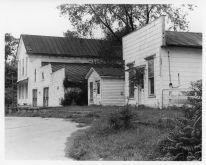 Commercial district buildings along Route 110, c. 1977
 -
 Interior of Cheap Cash Store showing original elaborate shelving with arched units, c. 1977
 -
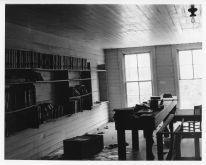 Interior of former bank building (later used as post office), c. 1977
 -
 Dilapidated watchman's quarters outbuilding near commercial district, c. 1977
 -
 Former bank building (later used as post office) with false-front facade, c. 1977
 -
 Iron arch beam bridge spanning Rough River, view from riverbank, c. 1977
 -
 Stone masonry abutment of the 1877 iron bridge, viewed from bridge deck, c. 1977
 -
 Deteriorated log outbuilding amid overgrown vegetation, c. 1977
 -
 Grist mill and wool mill buildings from the Rough River, showing limestone foundation and millrace dam, c. 1977
 -
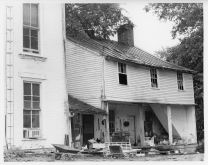 Rear of the Willis Green House showing deteriorated back porch and kitchen wing, c. 1977


References
- Morrissey, Jim. "Falls of Rough: Oasis of the Past." Courier-Journal Magazine, October 27, 1963.
- McKinney, R.H. "Falls of Rough, Kentucky." The Leitchfield Gazette, November 1903 (reprint April 5, 1973).
- St. Clair, Burl. "Rough River Country." The Leitchfield Gazette, April 5, 1973.
- Westerfield, Thomas W. "Lafayette Green." Kentucky Genealogy and Biography. Owensboro: Genealogical Reference Co., 1970.
- National Register of Historic Places Nomination: Green Family Farm Historic District (78001305). Kentucky Heritage Council, 1977.